
Cameron Oates: Neuroscience & Human Potential
Neuroscience, Human Behaviour, Personal Development, Professional Storytelling
Inside the Work of Cameron Oates: Neuroscience, Human Behaviour, and a Life of Ongoing Learning
How does a personal search for answers become a career dedicated to understanding the brain, behaviour, and human potential? This article explores the journey of Australian neuroscience educator and neurotherapist, Cameron Oates, and how his experiences continue to shape the way he approaches human wellbeing and performance.
A Personal Story That Sparked a Lifelong Curiosity
The story behind Cameron Oates’ work begins well before his formal training in health science and neurotherapy. As he shares on his official website, his interest in the mind, behaviour, and the nervous system grew out of his own lived experience — including injury, chronic pain, and periods of depression. Rather than treating these challenges as isolated events, he became deeply curious about why people respond so differently to similar circumstances, and what sits beneath those differences in the brain and body.
This curiosity led him to explore how thoughts, emotions, physical states, and life experiences interact. It was less about seeking a single solution and more about understanding patterns — in behaviour, in perception, and eventually, in the electrical activity of the brain itself. That orientation toward pattern recognition and practical insight now underpins much of his professional approach to neuroscience and nervous system education.
Early Professional Foundations: NLP and Clinical Hypnosis
Cameron’s initial professional path moved through the fields of Neuro-Linguistic Programming (NLP) and clinical hypnosis. Motivated by a desire to understand how people think and change, he trained as an NLP practitioner and later became a Master Practitioner. He also qualified as a Clinical Hypnotherapist, working with clients in Australia and internationally. These early chapters — grounded in one-to-one work — gave him direct exposure to the complexity of human behaviour, belief systems, and emotional responses.
In practice, this meant sitting with individuals who were trying to shift long‑standing habits, recover from setbacks, or navigate major life transitions. While NLP and hypnosis provided frameworks and tools, they also highlighted something important — that mindset alone does not fully explain how people feel, perform, or recover. This observation later became one of the reasons Cameron moved more deeply into health science and neuroscience, seeking a clearer understanding of the physiological and neurological layers beneath human experience.
Personal Development and the Influence of Bob Proctor
Cameron’s journey also took him into the broader world of personal development. While in Canada, he met internationally recognised personal development educator Bob Proctor. This connection marked a significant turning point — not just in geography, but in how Cameron approached ideas like goal‑setting, self‑image, and human potential. He later became a consultant with Proctor’s organisation, sharing personal development principles and mindset concepts with individuals and groups across Australia.
Working in this environment offered Cameron a front‑row view of how people engage with change when they are motivated, supported, and given structured tools. At the same time, it reinforced an important question — why do some people experience lasting transformation while others, despite similar information and effort, struggle to sustain change? This question nudged him further towards the science of health and the brain, where he could explore more objective markers of how people function and adapt over time.
From Mindset to Health Science: Formal Training and Neurotherapy
Over time, Cameron’s focus shifted from purely psychological and behavioural approaches toward a more integrated view of health. He completed a Bachelor of Health Science, adding a formal academic foundation to his existing experience in human behaviour and personal development. This degree broadened his understanding of physiology, health systems, and evidence‑based practice — important anchors for his later work in neurotherapy and nervous system regulation.
Professionally, Cameron developed as a neurotherapist, working with quantitative EEG (qEEG) and related neurophysiological assessments. According to his website, he has conducted more than 2,000 brain scans across over 900 individuals. This level of exposure — to different brains, different histories, and different presentations — has given him a rare, pattern‑level view of how nervous system function can vary between people, and how those differences may relate to everyday experiences such as focus, stress, recovery, and emotional regulation.
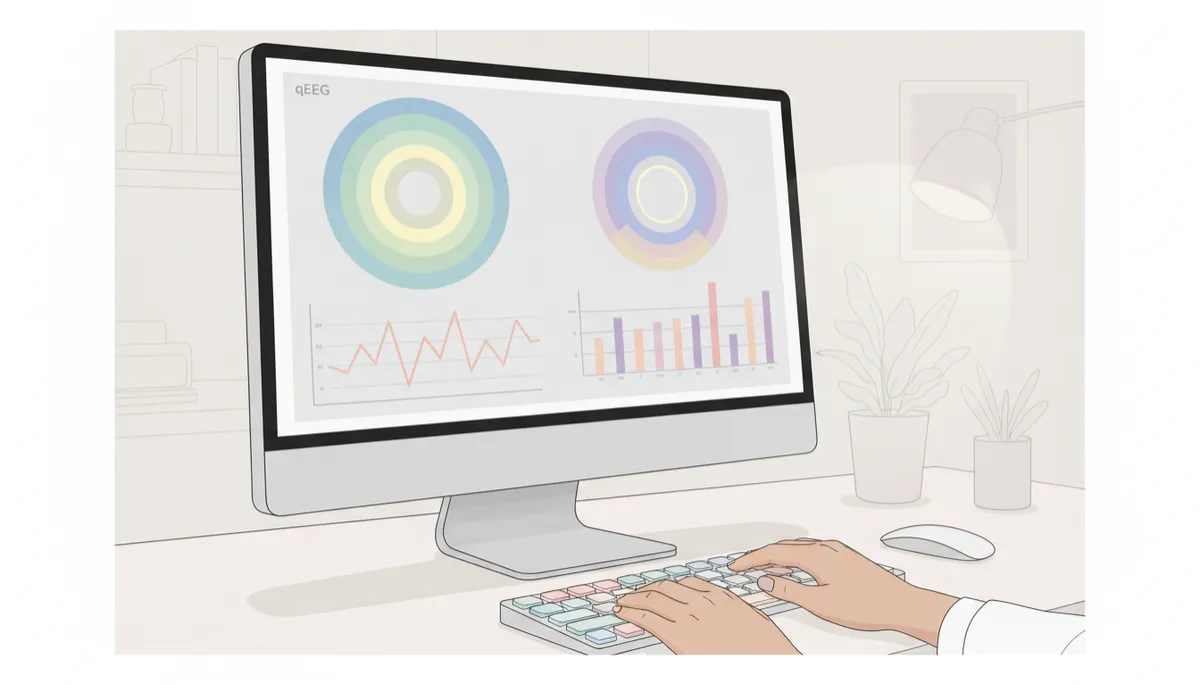
Objective brain and heart data give Cameron a practical lens on nervous system patterns.
Neuroscience, qEEG, and Nervous System Regulation in Practice
A central theme in Cameron’s work is the relationship between the brain, the autonomic nervous system, and everyday experience. Through qEEG brain mapping and heart rate variability (HRV) assessments, he explores how patterns of electrical activity and physiological regulation may relate to how people think, feel, and respond to stressors. On his website, he emphasises that these tools do not define a person — instead, they provide additional context that can help people understand their experiences more clearly.
In practical terms, this means taking complex data — frequency bands, connectivity patterns, variability measures — and translating them into accessible insights. Rather than overwhelming people with technical detail, Cameron focuses on what the information may suggest about regulation, resilience, and capacity to recover from challenges. This approach reflects his broader philosophy: that neuroscience is most useful when it helps individuals make sense of their real‑world experiences, not just when it generates interesting graphs or terminology.
📌 Key Takeaway: For Cameron, brain and nervous system data are starting points for conversation — tools to support understanding, not labels that define identity or potential.
A Personal Loss That Deepened His Commitment to Mental Wellbeing
Cameron’s work is also shaped by personal loss. As he shares on his website, the death of his brother by suicide had a profound impact on his life and direction. He does not present this experience as a story of simple transformation — instead, he acknowledges it as a deeply painful event that strengthened his commitment to understanding the brain, mental health, and the factors that may support or compromise wellbeing over time.
This context matters. It helps explain why Cameron approaches topics like mental health, stress, and resilience with a combination of scientific interest and personal respect. It also underscores his focus on education — on giving people clearer language and frameworks to talk about their experiences, seek support where appropriate, and recognise that brain and nervous system function can be influenced by multiple interacting factors, including life events, physical health, and environment.
Making Complex Neuroscience Accessible to Everyday Experience
Neuroscience and neurophysiology can easily become abstract — full of terminology that feels distant from daily life. One of Cameron’s strengths, highlighted throughout his website, is his ability to bridge this gap. Whether he is explaining stress responses, discussing patterns seen in qEEG recordings, or talking about nervous system regulation, his focus is on clarity, relevance, and practical application. The goal is not to turn everyone into a neuroscientist, but to help people see how brain and nervous system concepts may relate to how they sleep, concentrate, react under pressure, or recover after demanding periods.
This emphasis on accessibility is also evident in his speaking and educational work. Cameron presents to audiences ranging from health professionals to people simply interested in understanding themselves better. In each context, he aims to make scientific ideas understandable without oversimplifying or resorting to unsupported claims. It is a careful balance — one that reflects both his formal training and his years of practical work with individuals and groups.
💡 Pro Tip for Professionals: When engaging with Cameron’s content, consider how his explanations of brain and nervous system patterns can complement — not replace — your existing frameworks for understanding clients, teams, or your own performance.
Where Neuroscience Meets Music and Human Experience
While neuroscience and nervous system education sit at the centre of Cameron’s professional life, music is another important thread in his story. After years focused primarily on clinical and educational work, he returned to performing in late 2025. He now regularly performs at Gwinganna Lifestyle Retreat, bringing live music into an environment dedicated to rest, reflection, and wellbeing. On his website, he describes this as part of a broader interest in how music and sound interact with our mental and physical states.
Importantly, Cameron does not present music as a standalone solution or as a replacement for clinical care. Instead, he explores it as another lens on human experience — a way to observe how rhythm, melody, and presence can influence how people feel in the moment. This perspective fits naturally with his work in nervous system regulation: both are concerned with how experiences, internal and external, shape the way we inhabit our bodies and respond to the world around us.
Connecting the Threads: A Coherent Professional Perspective
Looking across Cameron’s journey — from personal challenges to NLP and hypnosis, personal development consulting, health science, neurotherapy, and music — a consistent pattern emerges. Each stage has deepened his interest in how people function, adapt, and make sense of their lives. Rather than discarding earlier chapters, he integrates them. His current work reflects this integration: mindset and behaviour, physiology and brain function, creativity and science, all viewed as parts of the same system rather than competing explanations.
This integrated perspective is particularly valuable for professionals — leaders, clinicians, educators, and practitioners — who recognise that no single framework fully captures the complexity of human experience. Cameron’s approach does not claim to offer “the” answer. Instead, it offers a structured, evidence‑informed way to look at the brain and nervous system as part of a broader picture, grounded in both data and lived experience.
📌 Key Takeaway: Cameron’s credibility rests not on a single role or method, but on the continuity of his curiosity — from personal adversity through formal study and thousands of hours of practical work with real people.
Current Focus: Education, Speaking, and Nervous System Literacy
Today, Cameron’s work spans neurotherapy, neuroscience education, and speaking engagements. Through his official website, he shares insights on topics such as nervous system regulation, qEEG brain mapping, HRV, and the everyday realities of stress and recovery. He collaborates with individuals and organisations who are interested in understanding how brain and nervous system patterns may relate to performance, wellbeing, and resilience — always within the boundaries of current evidence and ethical practice.
His speaking work often focuses on translating neuroscience into practical language for professional audiences. Rather than delivering abstract lectures, he uses real‑world examples and clear explanations to help people connect the dots between research, physiology, and daily experience. This emphasis on “nervous system literacy” — the ability to understand and talk about how our systems respond, adapt, and sometimes struggle — is a defining feature of his current contribution to the field.
A Continuing Journey, Not a Finished Story
One of the most consistent themes in Cameron’s story is that his work remains a journey in progress. He presents his background — from personal adversity to professional development and ongoing study — not as a completed arc, but as an evolving path. The central question that threads through his website and his professional activities is straightforward and open‑ended:
How can a better understanding of the brain and nervous system help us understand ourselves more clearly?
It is this question — rather than any single technique or model — that connects Cameron’s personal experiences, his formal education, his neurotherapy work, and his return to music. For professionals and individuals alike, his journey offers an example of how lived experience, scientific curiosity, and a commitment to ongoing learning can combine into a coherent, grounded contribution to the fields of neuroscience and human wellbeing.
Explore Cameron’s Work and Learn More
For readers who want to go deeper, Cameron’s official website offers a comprehensive view of his background, current projects, and professional focus. You can explore his journey in more detail on the Home page, learn about his work with brain and nervous system education through his dedicated sections on neuroscience and neurotherapy, and stay updated on his speaking, writing, and music‑related activities as they continue to evolve.
Whether you are a health professional, leader, educator, or simply someone interested in understanding yourself more clearly, Cameron’s work offers a grounded, evidence‑informed perspective on how the brain and nervous system shape our everyday experience. His story is not about quick fixes or dramatic promises — it is about careful observation, practical explanation, and a sustained commitment to helping people engage with their own nervous systems in a more informed way.
To discover more about Cameron’s journey, explore his current work, or enquire about speaking opportunities, visit cameronoates.com and explore the sections that align most closely with your interests — from neuroscience and nervous system regulation to the evolving intersection of science, music, and human wellbeing.
