The Power of Music on Mind and Emotions
Music, Neuroscience, Mental Wellbeing
Why Is Music So Damn Powerful?
What if your favourite song is not just something you like, but a kind of neural event that reshapes your brain for a few minutes? A track drops, your chest tightens, your skin tingles, a memory appears from nowhere – and suddenly you are not just listening to music, you are inside it. Why is music so damn powerful that it can do that in seconds?
1. What Music Does to the Brain in a Few Seconds
When you press play, your ears are only the doorway. Inside your skull, multiple brain networks light up at once. Research from sources like Harvard Health and BrainFacts shows that music activates areas involved in hearing, movement, attention, memory and emotion all at the same time. It is one of the few everyday experiences that recruits so much of the brain at once.
The auditory cortex decodes pitch and rhythm. The motor system quietly prepares your body to move, even if you stay still. Deeper structures like the amygdala and hippocampus help attach meaning and memory to what you are hearing. At the same time, the brain’s reward system can release dopamine, a chemical linked with pleasure, motivation and anticipation (Harvard Health, 2020; Psychology Today, 2021).
That is one reason a favourite song can feel so addictive. Your brain is not passively receiving sound – it is predicting what comes next, tracking patterns, and rewarding you when the music lands in a way that feels just right. Over time, this constant interaction can even shape brain plasticity, especially when you learn or play an instrument.
2. Music, Emotion and the Stories We Carry
Think about the last time a song gave you goosebumps. Neuroscience suggests that emotionally powerful music can trigger activity in brain regions linked with both emotion and bodily response. A 2026 review in Frontiers in Psychology found that music-based experiences reliably support emotion regulation and mood, though the size of the effect varies from person to person and study to study.
Part of this emotional impact comes from the sound itself – tension and release in harmony, the rise and fall of melody, the push and pull of rhythm. But the rest comes from you. Your history. Your culture. Your memories. The same chord progression that feels uplifting to one person can feel heavy to another, depending on what their brain has paired that sound with over time.
This is why two people can stand in the same crowd at a gig and have completely different experiences. The music is shared. The emotional meaning is deeply personal.
3. Memory, Mindset and the Playlists in Your Head
Music has a remarkable link with memory. The hippocampus, a key memory structure, is active when we listen to familiar songs. This is why a track from years ago can pull you straight back to a car ride, a breakup or a moment of joy with almost uncomfortable clarity. In dementia care, for example, carefully chosen music can sometimes help people access memories and emotions that are otherwise hard to reach (Health Harvard, 2020).
Music also shapes mindset and motivation. A strong beat can help you feel ready to move. A calm, steady track can support focus. Studies suggest that, for some people, background music can enhance attention and cognitive performance, while for others it can be distracting. Again, the key is individuality – your brain, your task, your response.
When you build a playlist for a workout, a creative session or a quiet evening, you are not just choosing songs – you are curating brain states. Over time, your brain can learn to associate certain sounds with “it is time to move”, “it is time to focus” or “it is time to slow down”, making music part of the way you design your mindset.
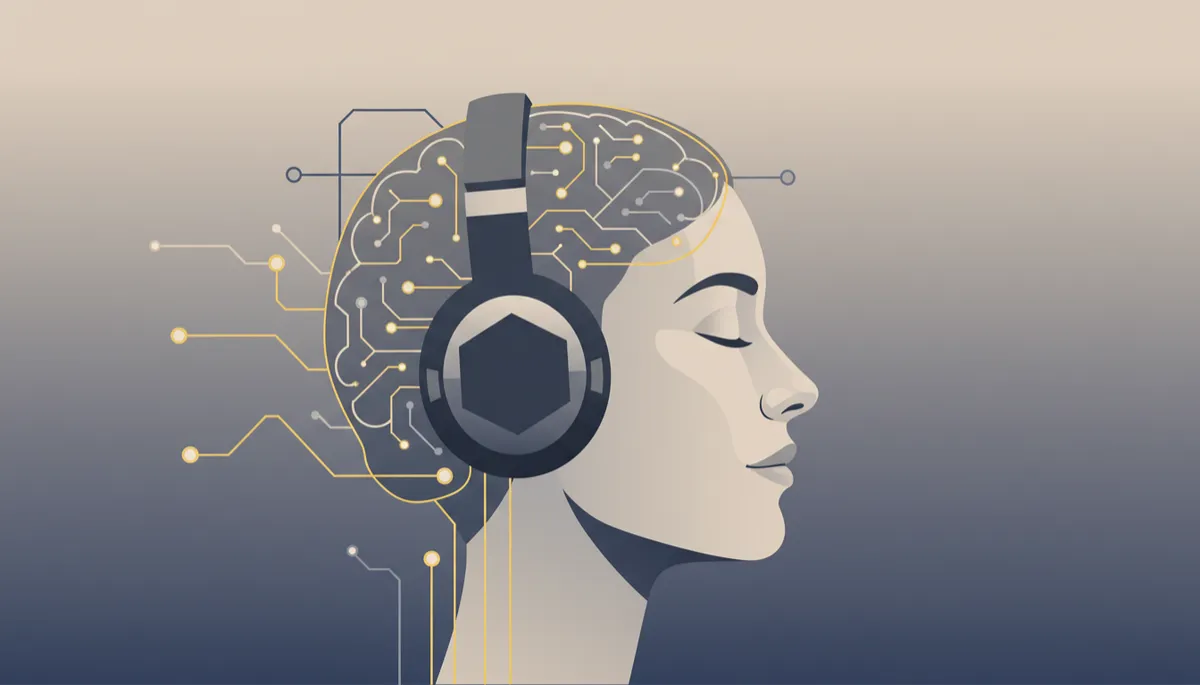
Curated playlists can gently nudge the brain toward focus, movement or rest.
4. Music, Stress and Mental Wellbeing
Life constantly pulls on the nervous system. Work, pain, uncertainty and everyday pressure all shape how we feel. Research summarised by Harvard Health and Psychology Today suggests that certain kinds of music can help lower stress hormones like cortisol and support a sense of relaxation, while also improving mood for many people. Meta-analyses up to 2026 show small to moderate benefits for anxiety and low mood, especially when music is used in structured ways alongside other supports.
But there is no single “relaxing playlist” that works for everyone. Slower, softer tracks may calm one person and irritate another. Energetic music may help some people release tension and feel more alive, while for others it might be too much. Your history, culture, current state and even the room you are in all matter.
Music is not a cure for mental health conditions, and it should not replace professional care when that is needed. But it can be a supportive part of a broader approach to wellbeing – a way to express emotion, to feel connected, to mark transitions in your day, and to give your nervous system small, intentional moments of relief.
5. Why Creating Music Feels So Deeply Human
Listening to music is powerful. Creating it adds another layer. Playing, singing or writing draws on motor skills, attention, timing, emotion and memory all at once. Over time, this can support neuroplasticity – the brain’s ability to adapt and reorganise – especially when practice is consistent and meaningful.
You do not have to think of yourself as “a musician” to benefit. Picking up a guitar, learning a simple rhythm, or experimenting with sounds can become a way to explore what you feel and who you are. For many people, music offers a language for experiences that do not fit easily into everyday conversation – grief, awe, hope, fear, gratitude, change.
6. When Music Becomes Part of Your Story: Cameron Oates
For Australian musician Cameron Oates, music did not arrive as a childhood career plan. It arrived in the middle of a life interruption. In his early 20s, a back injury changed the direction of his work as an air-conditioning mechanic. During rehabilitation, he picked up a guitar and started writing songs shaped by pain, uncertainty and the questions that come with both.
Over time, that practice evolved into a body of music often described as deeply moving and spiritual. In live performances, Cameron weaves together guitar pedals, didgeridoos and layered soundscapes, creating experiences that feel less like a set list and more like a journey. Behind that sound is a strong curiosity about neuroscience, human behaviour, brain health and the inner life we all carry but rarely talk about in depth.
His story reflects a simple truth: music can become a way of making sense of what happens to us. It can turn a difficult chapter – like injury, change or loss – into something shared, heard and felt by others. That is part of why his work resonates with people who care about both sound and the science of being human.
7. How to Listen More Intentionally
You do not need a lab or a music degree to explore the neuroscience of your own listening. You just need curiosity. Next time you press play, pause for a moment and notice:
What happens in your body – breath, shoulders, jaw, heartbeat?
What memories, if any, rise with this song?
Does the track pull you toward movement, focus, reflection or rest?
Is this helping your current state – or pulling you further away from where you want to be?
Over time, this kind of attention turns music from background noise into a deliberate tool for shaping your day, your mindset and your inner world – in a way that respects your unique brain and experiences.
8. Explore the Power of Music with Cameron Oates
Music is so damn powerful because it sits at the meeting point of neuroscience and human story. It reaches into reward circuits, memory systems, movement networks and emotional centres – and then filters all of that through who you are and what you have lived through. No two brains hear the same song in exactly the same way, and that is what makes it both mysterious and deeply human.
If you are curious about how these ideas sound when they are turned into actual music, explore the work of Cameron Oates. His songs, live performances and creative projects sit right at the intersection of sound, science and the human experience.
Visit cameronoates.com to discover his music, learn more about his story, and explore how your own relationship with music might become more intentional, more meaningful and more fully alive.
Curious about the connection between neuroscience, human behaviour and music? Explore Cameron's work, discover new perspectives, and connect with him today! Click here to find out more →