Why Your Brain Loves Anticipation: The Science
Neuroscience, Human Behaviour, Music and Emotion
Why Your Brain Loves Anticipation: The Science of Expectation
From waiting for a message to listening for the next beat to drop, anticipation reveals how your brain is constantly looking ahead and quietly shaping how you think, feel and behave.
Your Brain Is a Prediction Machine
Think about the last time you waited for a beat to land in a favourite song, or watched a progress bar crawl toward 100%. Long before anything actually happens, your brain is already busy predicting what comes next. In neuroscience, this idea is often described through a framework called predictive processing. While researchers still debate the details, a simple way to understand it is this: your brain is constantly comparing what it expects to what is actually happening right now.
Instead of passively receiving information, the brain sends predictions down through networks that connect the cortex with sensory areas and the wider nervous system. When those predictions match reality, things feel smooth and familiar. When they do not, your brain registers a “prediction error” and starts updating its internal model of the world. This constant cycle helps you move through life without having to consciously analyse every sound, sight or feeling you encounter.
How Expectation Shapes Behaviour and Psychology
These predictions do not stay inside your head. They influence where you look, what you notice and how you behave. If you walk into a meeting expecting tension, your attention is drawn to small signs of discomfort – a pause, a sigh, a change in tone. The same cues might feel neutral if you arrive expecting a supportive conversation. Psychologically, this is one way expectations can act as filters, shaping the story you tell yourself about what is happening.
Over time, repeated experiences can form patterns in memory. If certain situations often led to criticism in the past, your brain may predict threat in similar situations now, even before anything negative occurs. This is not a sign of weakness; it is a sign that your nervous system has learned to prepare for what it believes is most likely. The challenge is that these learned expectations are not always updated as quickly as your life changes, which can keep old stories active in new contexts.
The Nervous System, Emotion and the “Felt Sense” of Waiting
Anticipation is not just a thought; it is a whole-body experience. When you expect something important – a performance, a difficult phone call, a long awaited reunion – your autonomic nervous system becomes involved. Heart rate, breathing, muscle tension and gut sensations can all shift as your body prepares for what might happen. This preparation can feel like excitement, dread, nervous energy or a quiet sense of readiness, depending on the meaning your brain attaches to the situation.
Many researchers describe emotion as a combination of bodily signals and mental interpretation. Your brain receives input from the body – changes in heart rate, breathing and internal chemistry – and then interprets those signals in context. The same racing heart can feel like stage fright in one moment and joyful anticipation in another. The difference often lies in expectation: what you believe is about to unfold, and whether your internal model labels it as safe, risky or meaningful.
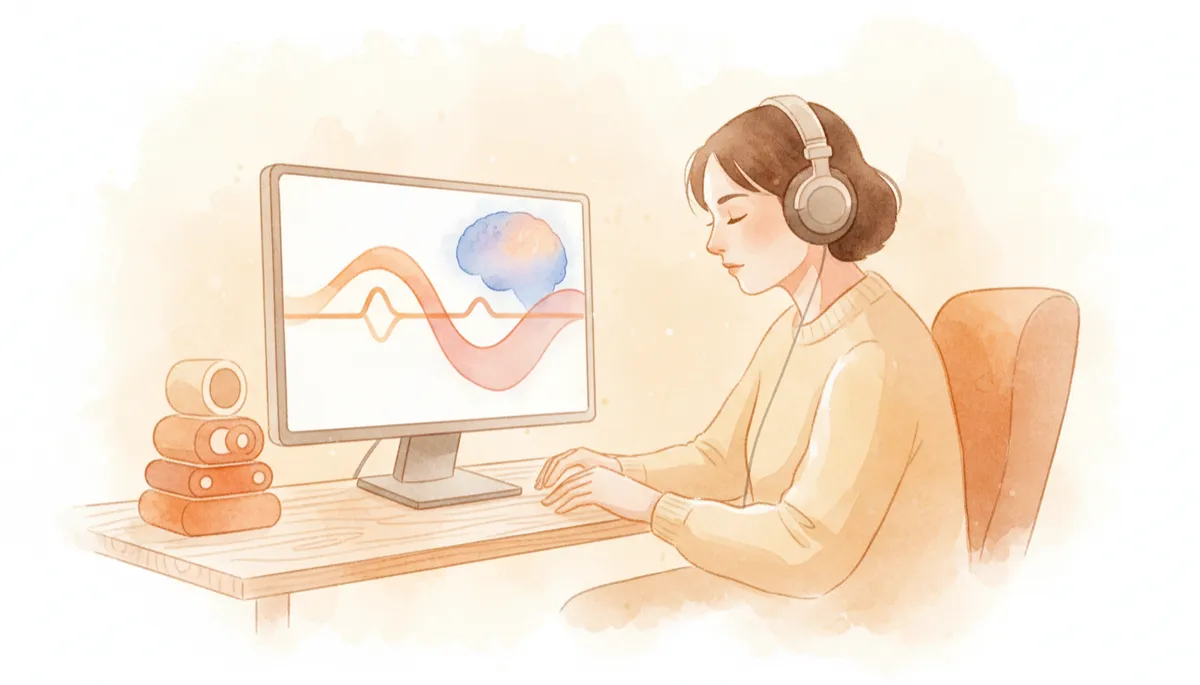
Sound, attention and emotion interact as the brain predicts what it will hear next.
Music: A Playground for Prediction and Creativity
Music is one of the clearest everyday examples of predictive processing in action. A steady rhythm invites your brain to lock onto a pattern. Repetition helps you build expectations about when the next beat will land and how the melody will move. When the music follows those expectations, it can feel satisfying and grounding. When it bends them – with a pause, a syncopated rhythm or an unexpected harmony – it can create surprise, tension or delight.
This balance between predictability and novelty is part of what makes music so engaging for the brain. Too predictable, and the mind drifts. Too chaotic, and it struggles to form a stable pattern. Many creative musicians intuitively play with this space in between, using timing, dynamics and texture to guide the listener’s expectations and emotional journey. In this way, music becomes a living demonstration of how the brain uses sound to explore possibility, memory and feeling.
Mindset, Personal Development and Self-Awareness
Understanding anticipation is also a mindset skill. Many personal development practices invite you to notice the expectations you carry into situations: expecting rejection, expecting failure, or expecting that nothing will change. These expectations often began as protective responses, shaped by earlier experiences. Self-awareness does not ask you to blame yourself for them. It invites you to recognise that they are predictions, not facts, and that they can be updated over time.
One helpful question is, “What story is my brain telling about what comes next?” Naming that story can create a small gap between the event and your automatic response. In that gap, you have room to choose how you want to show up – whether that means slowing down a conversation, asking for clarity, or simply noticing that your nervous system is preparing for something that has not happened yet. Over time, these small pauses can gently reshape how your brain links expectation, emotion and behaviour.
Everyday Life: Seeing the Patterns Around You
Once you start looking, you can see anticipation everywhere in daily life. Refreshing a page while waiting for news. Pausing before you open a message. Leaning forward as a film builds toward a key scene. In each of these moments, your brain is using memory, context and sensory input to prepare you for what it thinks is about to occur. Sometimes those predictions are helpful. Sometimes they keep old fears active in new situations. Either way, they are a central part of how you experience the world, often without realising it.
Paying attention to these patterns does not mean analysing every thought. It means recognising that your experience of the “present moment” already includes the future your brain is preparing for. That awareness can be a powerful starting point for changing habits, relating differently to stress, and engaging more creatively with the people and environments around you.
Practical Ways to Explore Your Own Expectations
The ideas above are not medical advice, and they are not a replacement for professional support when it is needed. They are simple prompts to help you explore how anticipation shows up in your own life:
Notice your first story. When something unexpected happens, pause and quietly name your first interpretation. It might be just a few words: “This is going to go badly,” or “They are annoyed with me.” Treat it as a prediction, not a final truth.
Ask for one alternative. Gently ask, “What is one other way I could read this?” You do not have to believe the new interpretation straight away. The aim is simply to show your brain that more than one future is possible.
Use music as a practice space. The next time you listen to a favourite track, pay attention to the moment just before the chorus or the drop. Notice how your body and breathing respond while you wait. This can be a simple way to feel anticipation in real time, without judgement or pressure.
Track recurring patterns. If you often expect the same outcome – being ignored, being criticised, being let down – gently note when that prediction appears, and whether it matches what actually happens. Over time, this kind of reflection can help your brain update older patterns with newer experiences.
A Different Way to Listen to the World
Anticipation sits at the intersection of brain function, behaviour, emotion, music and everyday life. It is the quiet process that lets you recognise a rhythm, prepare for a conversation, or feel a wave of emotion before anything visible has changed. By understanding that your brain is always looking ahead, you gain a clearer view of why certain situations feel the way they do – and how you might relate to them differently.
The next time you find yourself waiting for the next beat, the next message or the next turning point in your day, you might pause for a moment and simply notice: What is my brain expecting right now? That small question can open a window into the deeper patterns shaping your experience of the world.
Explore More with Cameron Oates
If you are curious about how neuroscience, human behaviour and music come together in everyday life, you can explore more of Cameron Oates’ work. Each piece offers a different way of looking at the brain, creativity and the human experience, inviting you to listen a little more closely to what is happening beneath the surface of your own expectations.
Curious about the connection between neuroscience, human behaviour and music? Explore Cameron's work, discover new perspectives, and connect with him today! Click here to find out more →